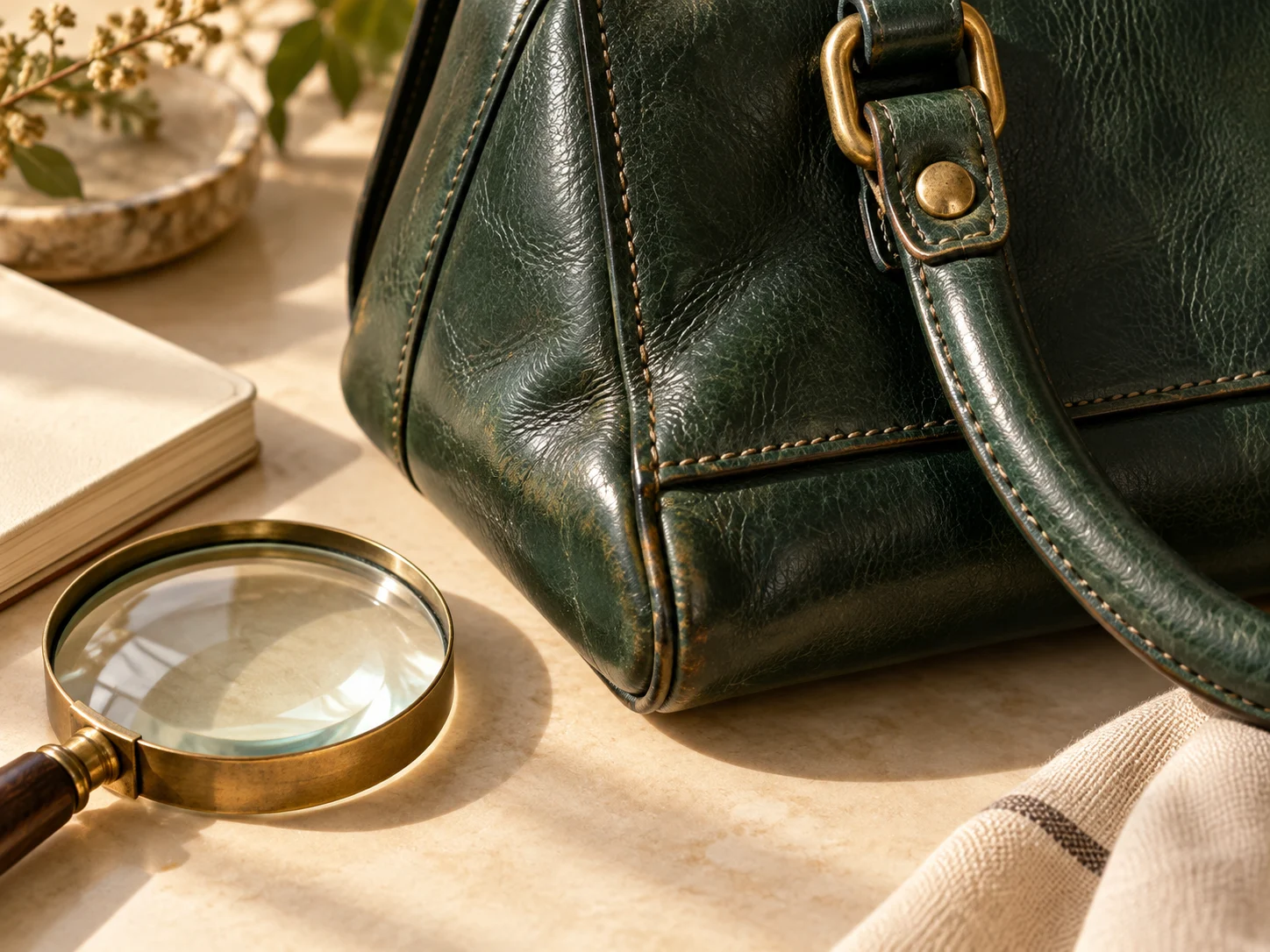
Commencez par la forme générale, puis comparez-la avec les vues latérales et de base.
La réponse rapide
Traiter les photos de sacs à main comme des preuves, pas de décoration. Commencez par des vues droites sur le devant, le dos, le côté et la base pour comprendre la forme et les proportions. Inspectez ensuite l'ouverture, l'intérieur, les coins, les coutures, la finition des bords, la quincaillerie et les attaches de sangle. Comparez les détails répétés sur plusieurs photos; forme, couleur et matériel cohérents sont plus informatifs qu'une image dramatique. Les photos tissées aident avec l'échelle, mais peuvent être déformées par la hauteur du modèle, le choix de l'objectif et le style. Demandez des mesures et une courte vidéo de lumière naturelle lorsque les photos omettent un angle critique. Une forte liste devrait vous aider à comprendre comment le sac semble vide, comment il s'ouvre et où les pièces portantes sont renforcées.
Séparer les images de présentation des images de preuves
Les photos de style de vie communiquent humeur, combinaisons de couleurs et l'échelle approximative. Ils peuvent utiliser un éclairage incliné, une mise au point peu profonde, des accessoires de style et une farce temporaire. Les images probantes sont plus neutres : vues rectilignes avant et arrière, vrais profils latéraux, base, ouverture, intérieur et détails étroits. Utilisez des photos de style de vie pour imaginer le style, mais utilisez des images probantes pour juger la construction et le fonctionnement.
Une liste n'a pas besoin de dizaines de photos, mais elle devrait répondre à des questions prévisibles. Tu peux voir la fermeture ouverte et fermée ? Les deux côtés sont montrés ? La base est-elle visible ? Les attaches à la sangle et les poches intérieures sont-elles claires? Lorsque des zones importantes sont cachées, demandez-les plutôt que de combler l'écart par des hypothèses. Les preuves manquantes ne sont pas la preuve d'un problème, mais elles limitent une comparaison confiante.
Vérifiez la silhouette naturelle et la symétrie
Commencez par le sac vide ou légèrement rempli. Comparez les côtés gauche et droit, la ligne supérieure, le positionnement de la poignée et la base. Les sacs souples ne sont pas parfaitement géométriques, mais l'asymétrie répétée peut révéler comment le matériau s'installe. Les sacs structurés doivent indiquer si les côtés restent droits et si la ligne supérieure est de niveau. Recherchez plusieurs angles avant de décider que la perspective de la caméra a causé la différence.
Le farcement peut faire apparaître un sac souple plus structuré et spacieux. Recherche d'une image montrant l'ouverture ou l'intérieur; les tissus lourds créent souvent des côtés arrondis et une base complète. Un profil latéral est d'autant plus utile qu'il révèle des effondrements, des guessets et si le corps s'effondre. Juger la conception en fonction de sa douceur voulue plutôt que de s'attendre à ce que chaque sac reste rigide.
Les images intérieures révèlent l'accès, les diviseurs et l'espace que les images extérieures ne peuvent pas montrer.
Utiliser soigneusement les références à l'échelle
Une photo de modèle ne fournit le contexte que lorsque la hauteur du modèle et les dimensions du sac sont connues. Un objectif grand angle peut agrandir un sac près de la caméra, tandis qu'un long objectif peut aplatir les proportions. Cropping peut se cacher là où un sac de corps se trouve réellement. Comparer le sac avec la main, l'avant-bras et le torse sur plusieurs images, puis revenir aux dimensions écrites pour la décision finale.
Les objets familiers peuvent également induire en erreur parce que les tailles du téléphone et du portable varient. Une règle, une bande de mesure ou une vidéo claire est mieux. Lorsqu'il n'y a pas de référence d'échelle, créez votre propre plan papier à partir de la largeur et de la hauteur indiquées. Cela transforme une image de produit abstraite en comparaison physique et révèle si le sac va dominer ou disparaître contre votre corps.
Inspecter l'ouverture et la disposition intérieure
Une photo en sac ouvert devrait révéler la largeur utilisable, le chemin de fermeture à glissière, le mouvement des volets et la distance entre les côtés. Recherchez une fermeture à glissière encastrée, des plis vers l'intérieur ou un cadre rigide qui peut réduire l'accès. Les diviseurs d'intérieur peuvent améliorer l'organisation mais aussi limiter les articles encombrants. Vérifiez si les poches atteignent la base ou flottent au-dessus, car de petits objets peuvent se déplacer sous des diviseurs flottants.
La couleur du linge affecte la visibilité. Un intérieur sombre peut rendre les petits objets plus difficiles à trouver, tandis qu'une doublure très légère montre des marques plus facilement. Examinez les coutures autour des poches, des extrémités de fermeture éclair et des onglets d'attache. Les photos de produit ne peuvent pas s'avérer durables à long terme, mais elles peuvent montrer si les zones porteuses reçoivent un renforcement visible et si la disposition correspond à votre routine.
Lire les photos du matériel et des pièces jointes
Les gros plans du matériel doivent montrer la finition, la forme et les points de connexion réels. Comparez le même matériel sur les photos sous un éclairage similaire; les lumières chaudes et fraîches peuvent changer la tonalité métallique. Regardez les anneaux, les clips, les glissières, les pieds et les serrures d'une distance suffisante pour comprendre l'échelle. Des images macro extrêmement proches peuvent exagérer la texture minuscule tout en cachant comment le composant se rapporte au sac.
Les attaches à bande portent une force répétée. Vérifiez s'ils se connectent à des onglets en cuir renforcé, des panneaux latéraux ou des boucles décoratives. Les poignées supérieures doivent être placées uniformément. Si une sangle amovible est incluse, cherchez une photo montrant le sac suspendu. Un clip qui semble attrayant sur une table doit aussi tourner et s'asseoir correctement quand il est chargé.
Les photos du matériel et des coutures aident à expliquer la construction, mais l'éclairage doit rester cohérent.
Examiner les coutures, les bords, les coins et la base
Les coutures droites doivent paraître cohérentes, mais rappelez-vous que les matériaux mous se déplacent. Recherchez le chemin de couture autour des courbes et où se rencontrent plusieurs panneaux. La peinture de bord ou les bords repliés doivent être montrés dans le focus naturel plutôt que cachés par des reflets. Les coins révèlent comment le sac gère le contact avec les surfaces et si la tuyauterie ou les panneaux s'étendent au-delà de la base.
La base contrôle la stabilité et distribue la charge. Une base plate renforcée peut maintenir un sac de travail debout, tandis qu'une base douce crée une forme détendue. Les pieds lèvent légèrement le matériau mais n'empêchent pas tout contact. Vérifiez si les coutures de base s'assoient directement sur les surfaces et si le sac est photographié sur une table de niveau. Une surface inclinée peut rendre un côté plus long.
Comparer la couleur et la texture à travers l'éclairage
La couleur doit être évaluée dans plusieurs conditions d'éclairage. Studio lumière peut illuminer les nuances foncées, tandis que la lumière intérieure chaude peut jaune crème et beige. La lumière naturelle indirecte est la référence la plus utile. Comparez les photos à l'avant, à l'intérieur et portées pour la consistance. Les différences peuvent provenir de l'éclairage, des réglages de l'écran ou de la direction du matériau plutôt que de l'élément lui-même.
La texture change aussi avec l'angle. Le grain, la sieste en daim, le quilting et les surfaces tissées créent des reflets et des ombres. Une finition lisse peut refléter la pièce. Zoomez assez pour comprendre la texture, mais n'interprétez pas les artefacts de compression comme des défauts de surface. Une courte vidéo lente sous une lumière constante est souvent meilleure qu'une image immobile très aiguisée.
Demander une vidéo de détail utile
Demandez une vidéo simple plutôt qu'un clip promotionnel. L'élément doit être montré à l'avant, à l'arrière, des deux côtés et de la base, puis ouvert avec la caméra assez près pour voir l'intérieur. Les poignées et les sangles peuvent être levées doucement pour montrer le mouvement. La vidéo devrait comprendre un ruban de mesure au point le plus large, la hauteur, la profondeur de base et l'ouverture lorsque les dimensions sont importantes.
Le mouvement naturel révèle des détails qui cachent encore des photos : si un rabat se ferme facilement, si une fermeture éclair prend un coin, si un corps doux s'effondre et si une sangle tourne. Gardez les attentes réalistes parce que la compression vidéo et la couleur de l'écran varient encore. L'objectif est de répondre à des questions fonctionnelles spécifiques, et non de créer une inspection visuelle parfaite.
Utiliser une liste de contrôle photo finale
Avant de commander, confirmez la forme générale, l'avant et l'arrière, les deux côtés, la base, l'ouverture, l'intérieur, la fermeture, les coins, la quincaillerie et la sangle. Vérifiez que les mesures écrites correspondent aux proportions visuelles. Notez si le sac est montré vide, empaillé ou chargé. Enregistrez les photos de liste et la description afin que vous puissiez comparer l'élément reçu avec les informations fournies.
Ne vous fiez pas à une image attrayante ou à un détail négatif. Recherchez des modèles à travers l'ensemble complet. La meilleure décision en ligne combine photos, mesures, matériaux, utilisation prévue et réponses directes aux questions manquantes. L'imagerie claire du produit réduit l'incertitude, mais une photographie ne peut pas remplacer la vérification si les dimensions du sac et le style de transport correspondent à votre propre routine.
Foire aux questions
Combien de photos un sac à main doit-il avoir ?
Il n'y a pas de numéro fixe. L'ensemble doit couvrir la forme générale, tous les côtés, la base, l'ouverture, l'intérieur, la fermeture, les coins, le matériel et les sangles.
Les photos de modèle peuvent-elles être utilisées pour estimer la taille?
Seulement approximativement. La hauteur du modèle, le choix de la lentille et le changement d'échelle apparente, de sorte que les mesures restent nécessaires.
Pourquoi la couleur du sac à main est-elle différente entre les photos ?
La température d'éclairage, les réglages de l'écran, les finitions réfléchissantes et la direction du matériau peuvent tous modifier l'apparence.
Que dois-je demander lorsque l'intérieur n'est pas montré?
Demandez une vue dégagée, une disposition de poche, une doublure, une largeur d'ouverture et une courte vidéo montrant l'accès.
Guides connexes
Comment mesurer un sac à main avant d'acheter en ligne
Guide de la capacité des petits, moyens ou grands sacs
Guides pour sacs à main
Besoin d'aide pour comparer un article?
Examiner les mesures, les matériaux et l'utilisation prévue avant de commander. Pour des questions spécifiques au produit, contactez le support ORBUYBAG et demandez des photos claires, des dimensions et une courte vidéo de détail.
Conseils révisés : vérifiez la pièce, le devis et les conditions du service avant tout achat.