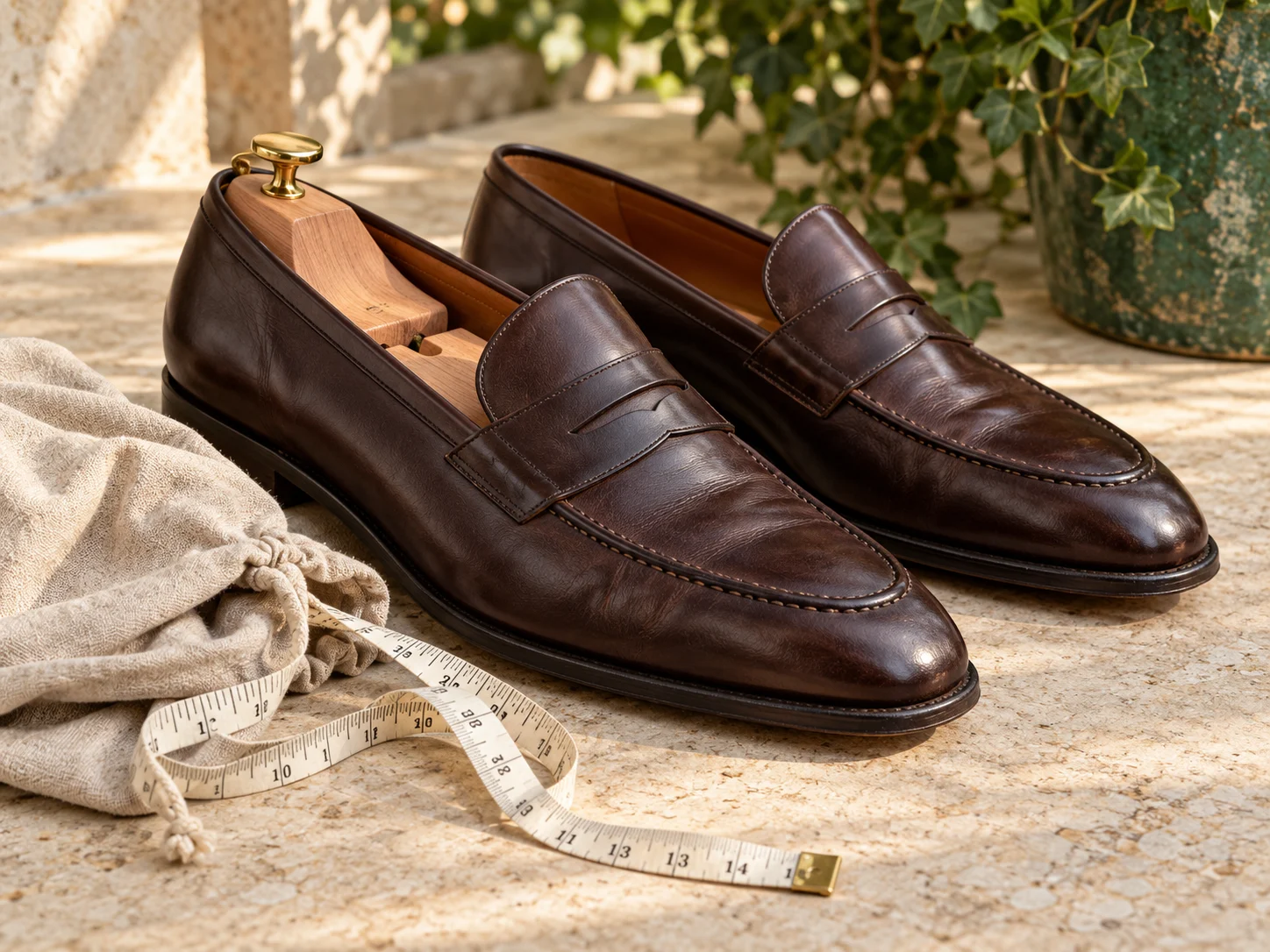
Un pied avant en forme de pied est souvent plus utile que de simplement choisir une taille plus longue.
La réponse rapide
Pour les pieds larges, choisissez une chaussure dont la semelle et la forme des orteils correspondent au pied plutôt que de ne compter que sur une taille plus grande. Mesurer la longueur, la largeur des pieds avant et la circonférence autour de la zone la plus large. Cherchez une boîte aux orteils arrondie ou anatomique, un volume d'étape adéquat et un laçage réglable. Le cuir ou le tissu souple peuvent s'adapter légèrement, mais aucune tige ne peut compenser une semelle trop étroite. Le talon doit rester en sécurité, de sorte que le calibrage de plusieurs longueurs est généralement moins efficace que le choix d'une dernière plus large.
Confirmez où le pied est large
Les pieds larges ne sont pas tous en forme de même. Certaines personnes sont larges à travers la balle du pied, d'autres ont un pas de grand volume, un milieu de pieds plus large ou des orteils qui se propagent naturellement. Une chaussure peut se sentir serrée dans une zone alors qu'elle est lâche ailleurs. Mesurez les deux pieds en position debout et notez où la pression se produit habituellement dans les chaussures actuelles. Cette information permet de distinguer un problème de largeur d'un problème de longueur, de volume ou de forme d'orteil.
Tracer les pieds ou utiliser une règle pour la longueur et la largeur, puis mesurer la circonférence autour du pied avant le plus large si possible. Comparez le pied plus grand avec le graphique du vendeur. Un numéro de largeur unique est utile, mais pas complet; la hauteur supérieure et le bout des pieds affectent également l'ajustement. Les photos d'en haut et du côté fournissent des indices sur le volume.
Choisir la bonne forme d'orteil
Un orteil arrondi, carré ou légèrement conique offre généralement une pièce plus utilisable qu'un dessin pointu. La largeur externe peut être trompeuse parce que les bords épais de la semelle ou les panneaux décoratifs ne représentent pas l'espace intérieur. Le plus long orteil et les orteils extérieurs devraient se trouver naturellement sans être poussés vers l'intérieur. La chaussure devrait se plier près de la balle du pied plutôt que de traverser les orteils.
Les personnes avec un pied avant large peuvent trouver qu'une chaussure décrite comme la largeur standard fonctionne lorsque la boîte d'orteil est en forme de pied, tandis qu'une taille large nominale peut encore se sentir restrictive si elle s'affaisse tôt. Demandez la largeur intérieure à la boule du pied et comparez-la avec une paire confortable. Assurez-vous que les deux mesures ont été prises à des points semblables.
Les photos de la vue supérieure révèlent l'espacement des yeux et le volume d'étape.
Ne pas résoudre la largeur seulement en ajoutant de la longueur
Le calibrage peut créer un peu plus de largeur parce que les dures deviennent souvent proportionnellement plus grandes, mais la longueur ajoutée peut déplacer le point de flexion et causer des glissements de talon. Le pied peut glisser vers l'avant, créant une pression des orteils malgré la chaussure plus longue. L'excès de longueur change aussi le creasing et la stabilité. N'utilisez une taille plus grande que lorsque la longueur et la largeur demeurent appropriées.
Une meilleure solution peut être une dernière plus large, une forme d'orteil plus généreuse ou une construction réglable. Lorsqu'un seul pied est plus large, adaptez le pied plus grand et utilisez un petit réglage de la semelle intérieure ou des conseils professionnels pour le côté plus petit plutôt que de forcer le pied plus grand dans une chaussure serrée.
Comprendre les limites matérielles
Le cuir souple peut se conformer modestement aux pieds avant, et le tissu ou le tricot peuvent accueillir des mouvements. Suede se sent souvent flexible, tandis que le cuir fortement revêtu et les panneaux synthétiques renforcés peuvent changer moins. Cependant, la plate-forme unique, les coutures et le capuchon d'orteil définissent les limites dures. Le matériel devrait se sentir confortablement en soutien dès le début, pas douloureusement serré avec une promesse d'étirement majeur.
Vérifiez où les recouvrements et les coutures traversent la partie la plus large du pied. Une couture peut créer une pression même lorsque la partie supérieure environnante est douce. Les finitions de type brevet et les protecteurs rigides des orteils peuvent être moins indulgents. Si un vendeur recommande l'effraction, demandez quelle partie devrait s'assouplir. La longueur et la largeur de la semelle ne s'étendront pas par une usure normale.
Utiliser le laçage et les fermetures intelligemment
Les lacets permettent d'ajuster le volume supérieur. Les chaussures avec une zone de laçage plus longue offrent généralement plus de flexibilité que les modèles avec seulement quelques oeillets. Les rangées d'œillets ne doivent pas être très éloignées, et la langue doit couvrir l'ouverture sans exposer la chaussette. Les moufles et les slip-ons nécessitent un dernier plus exact parce qu'il y a moins d'ajustement.
Un pas en avant élevé peut être bénéfique de sauter un passage sur la zone de pression ou d'utiliser un motif de laçage plus doux, mais le pied doit rester sûr. Les pailles devraient fermer sans être étendues à leur limite. Les réglages peuvent affiner une chaussure compatible; ils ne peuvent pas corriger une semelle fondamentalement étroite.
La partie supérieure peut s'adapter légèrement, mais la seule plate-forme doit déjà être assez large.
Vérifiez le talon et le contrôle du pied moyen
Un pied avant large ne signifie pas toujours un talon large. Beaucoup de gens ont besoin d'espace devant avec un arrière sécurisé. Cherchez un comptoir en forme de talon et un laçage qui retient le pied en arrière. Si le talon s'élève, le pied glisse et la pression peut se déplacer vers l'avant. Ajouter une semelle intérieure très épaisse pour remplir un talon lâche peut réduire le volume des pieds avant, donc faire des changements soigneusement.
Lors d'un test à l'intérieur, marcher, tourner et utiliser des escaliers. Le talon doit rester contrôlé et la zone de l'arche doit se sentir soutenue sans serrer. La chaussure ne doit pas tourner autour du pied. Un ajustement équilibré se sent spacieux là où le pied a besoin d'espace et sécurisé là où le contrôle est nécessaire.
Compte pour l'enflure et les chaussettes
Les pieds peuvent devenir plus pleins par temps chaud, de longues périodes de repos ou de voyage. Mesurez et essayez les chaussures plus tard dans la journée, et utilisez l'épaisseur normale de la chaussette. Un ajustement déjà serré le matin peut devenir inconfortable après des heures d'usure. Laisser la pièce contrôlée sans créer de glissement.
Chaussettes épaisses, semelles intérieures amorties et orthèses réduisent le volume intérieur. Confirmez si la semelle intérieure d'origine est amovible et si la profondeur de la chaussure peut accommoder l'installation prévue. Lorsqu'il s'agit d'instruments médicaux, suivre les conseils du professionnel compétent.
Questions à poser avant de commander
Demandez la longueur intérieure, la largeur intérieure des pieds avant, la largeur intérieure de la semelle et si la dernière est étroite, standard ou large. Demandez des photos de haute vue et une vidéo montrant la partie supérieure ouverte et laquée. Partagez les mesures en centimètres et expliquez où les chaussures précédentes se sentaient serrées. Une étiquette de taille sans ces détails n'est pas suffisante pour une décision confiante.
Comparez le candidat avec une chaussure confortable de construction similaire. Mesurez la semelle intérieure amovible si disponible, mais rappelez-vous que le pied peut s'étendre légèrement au-delà d'une semelle intérieure douce tout en restant à l'intérieur de la partie supérieure. Les termes de retour sont particulièrement importants pour essayer un nouveau dernier.
Signaux d'avertissement d'ajustement
La brûlure immédiate, l'engourdissement, la forte pression latérale, le chevauchement des orteils ou le gonflement visible au-delà de la semelle sont des signes d'avertissement. Les marques rouges qui persistent après un bref test à l'intérieur suggèrent également un mauvais match. Une légère fermeté globale peut être normale dans le cuir neuf, mais la douleur localisée ne doit pas être traitée comme une étape d'effraction requise.
Arrêtez les tests lorsque l'inconfort augmente. N'utilisez pas de chaleur, d'eau ou de force à la maison s'étirant sur les chaussures finies. Un étirement professionnel limité peut aider un point de pression mineur dans certaines constructions, mais il ne peut pas redessiner la forme de la semelle ou des orteils. Les symptômes persistants méritent d'être conseillés par un professionnel qualifié de la santé ou des chaussures.
Foire aux questions
Une grande taille est-elle toujours nécessaire?
Pas toujours. Une boîte d'orteils en forme de pied et un volume approprié peuvent fonctionner dans une étiquette standard, tandis que certaines chaussures à large marquage sont encore plus petites trop tôt.
Les grands pieds devraient-ils monter ?
Seulement quand la longueur ajoutée s'adapte correctement. L'excès de longueur peut provoquer un glissement du talon et déplacer le point flex.
Quels matériaux sont les meilleurs pour les pieds larges?
Le cuir souple, le daim et certains tissus peuvent s'adapter modestement, mais la semelle et la couture doivent déjà être adaptées.
Comment savoir si une chaussure est trop étroite ?
Cherchez une forte pression latérale, un engourdissement, une foule d'orteils, un gonflement au-delà de la semelle ou de la douleur qui apparaît rapidement lors d'un test à l'intérieur.
Guides connexes
Guide d'ajustement du sneaker en cuir
Guide de la taille des chaussures de l'UE
Guides pour la chaussure
Besoin d'aide pour comparer un article?
Examiner les mesures, les matériaux et l'utilisation prévue avant de commander. Pour des questions spécifiques au produit, contactez le support ORBUYBAG et demandez des photos claires, des dimensions et une courte vidéo de détail.
Conseils révisés : vérifiez la pièce, le devis et les conditions du service avant tout achat.